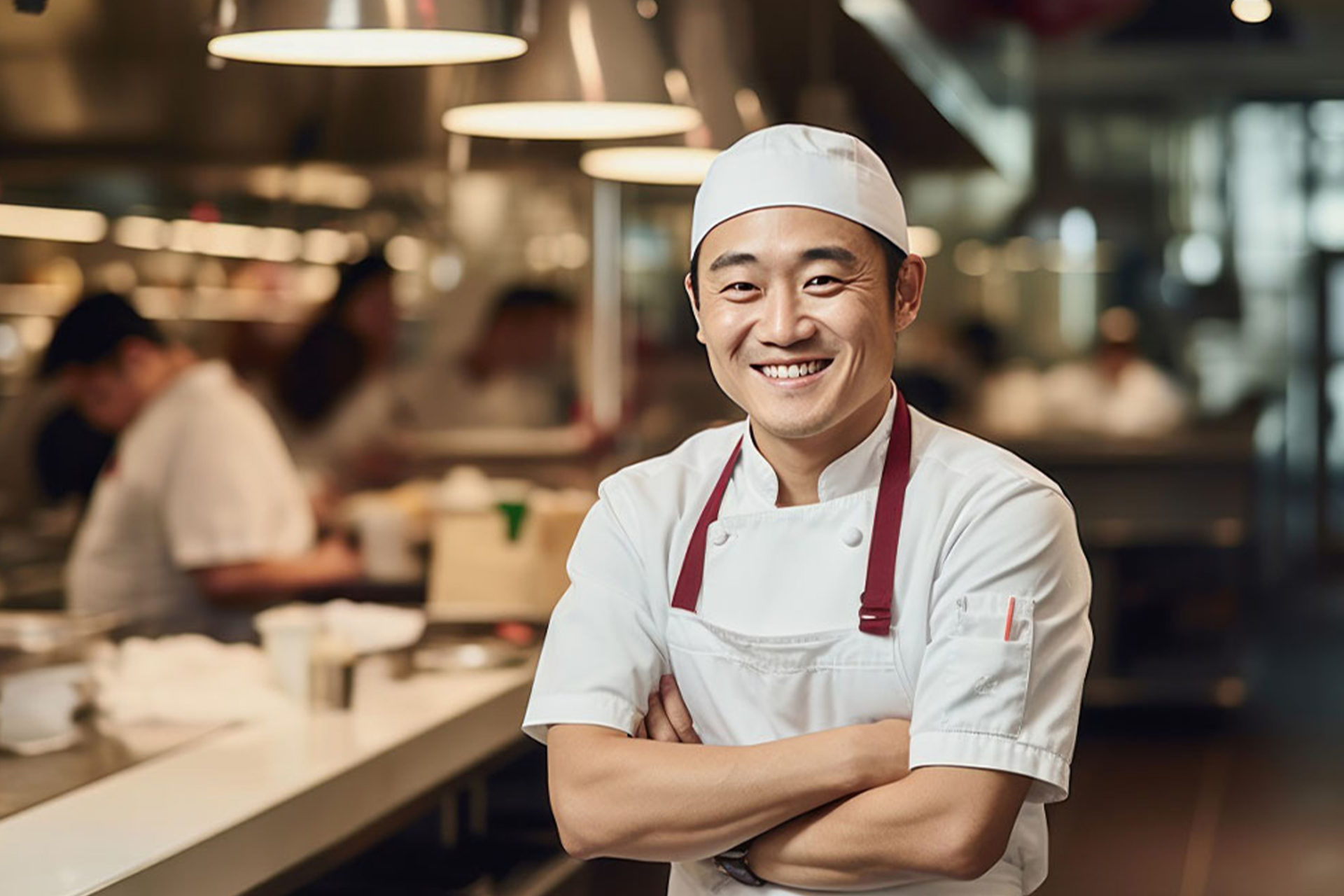

Hiring and Managing Japanese Chefs in South Korea: Visa, Salary and Retention (2026)
This guide answers the questions restaurant owners in South Korea ask us most often before hiring a Japanese chef from Japan. Salary ranges reflect the positions Washoku Agent has handled; visa facts come from official government pages, checked on 2026-10-29.
How much do Japanese chefs earn in South Korea?
Based on the positions Washoku Agent has handled in South Korea, advertised annual packages for Japanese chefs typically fall between JPY 8 and 10 million when converted, with the highest advertised packages reaching around JPY 12 million. These are offers at the time of advertising; the final package depends on city, concept and seniority.
Which roles and restaurant types hire Japanese chefs in South Korea?
The demand we see in South Korea is concentrated in a few role types and concepts. The most common roles are head chef and sous chef positions, and the most common concepts are teppanyaki, omakase sushi and Japanese cuisine.
Do Japanese chefs need to speak English, and is housing provided?
Nearly all of our listings accepted beginner-level English. Employers in South Korea generally prioritise cooking technique and experience; kitchen English develops on the job. Nearly all of our listings included housing or a housing allowance.
Which visa lets a restaurant in South Korea sponsor a Japanese chef?
A Specific Activity visa (E-7) in the semi-professional chef and cook category (E-7-2), based on a Confirmation of Visa Issuance that the restaurant obtains from its local immigration office. The Ministry of Justice manual names Japanese-cuisine chefs and cooks as an occupation that can be brought in, so a restaurant qualifies if it passes the floor area, VAT and Korean-staff test. Korea also has a working holiday agreement with Japan for chefs aged 18 to 25.
- Salary floor (Ministry of Justice notice 2025-406, for 1 February to 31 December 2026): KRW 25,890,000 a year for the E-7-2 category. The contract must state pay and hours, and both must clear the minimum wage.
- Chef qualification (manual, October 2026): an intermediate or higher cooking certificate; or an entry-level certificate plus 3 years of experience; or 6 months of formal training plus 5 years. Experience alone is not accepted for Japanese cuisine. Documents need an apostille or consular confirmation. No language test.
- Employer test: 60 square metres or more, KRW 3,000,000 or more of annual VAT paid, and 2 or more Korean staff on employment insurance for 3 months. The minimums allow 1 foreign cook; 2 cooks need 70 square metres, KRW 5,000,000 and 3 Korean staff. New restaurants usually wait 3 months after opening.
- No visa fee for Japanese nationals; the chef's visa is single-entry with a 2-year stay limit; extension KRW 60,000; the E-7 status can be granted for up to 3 years at a time.
- After the visa: entry, alien registration within 90 days (KRW 35,000). Embassy processing about one week for a chef holding the Confirmation of Visa Issuance (up to 2 weeks at the consulates), with an interview only if requested.
- Check that the restaurant passes the floor area, VAT and Korean-staff test and has 3 months of employment insurance records.
- The employer applies to the local immigration office for a Confirmation of Visa Issuance with the contract, the chef's certificate and experience letters (apostilled), the VAT certificate, the employment insurance list, floor-area proof and an identity guarantee.
- The immigration office issues the Confirmation of Visa Issuance number; the chef must apply for the visa within 3 months of issue.
- The chef applies at the Korean embassy or consulate in Japan (no fee for Japanese nationals, about one to two weeks, interview only if requested).
- Entry, start of work, and alien registration within 90 days (KRW 35,000); calendar the extension before the 2-year stay limit.
Which visa lets a Korean restaurant sponsor a Japanese chef?
The Specific Activity visa (E-7). The Ministry of Justice's visa issuance manual (October 2026 edition, posted on HiKorea on 22 October 2026) lists 'chef and cook' (주방장 및 조리사, occupation code 451, formerly 441) as one of the semi-professional occupations (E-7-2). The manual names 'Japanese-cuisine chef and cook' among the occupations that can be brought in, together with Western, Chinese and other foreign cuisines; Korean-cuisine cooks, snack-bar, coffee and traditional-tea cooks cannot. The restaurant applies to its local immigration office for a Confirmation of Visa Issuance (사증발급인정서); the chef then applies for the visa at a Korean embassy or consulate in Japan. The Employment Permit System (E-9) is for non-professional workers and does not cover chefs or cooks, as the Ministry of Employment and Labor stated in 2018.
What does the chef have to show, and what is the salary rule?
The manual sets the chef's qualifications by certificate, training and experience. A winner of an internationally recognised cooking competition is exempt from the certificate and experience rules. Otherwise, a chef trained outside Korea needs one of the following: an intermediate-level or higher cooking certificate (no experience needed); an entry-level certificate plus 3 or more years of experience after the certificate; or 6 months or more of formal culinary training plus 5 or more years of experience. The route of 10 years of experience without any programme is allowed only for local traditional food and is excluded for Japanese, Chinese and Western cuisine, so a Japanese chef with no certificate and no formal course does not qualify. Certificates, experience letters and course certificates must carry an apostille or a Korean consular confirmation (a 5-star hotel that selected the chef itself is exempt). The salary floor is published by the Ministry of Justice each year: for Confirmations of Visa Issuance from 1 February to 31 December 2026, semi-professional workers (E-7-2) must be paid at least KRW 25,890,000 a year (Ministry of Justice notice 2025-406 of 29 December 2025). Professional occupations (E-7-1) carry a higher floor of KRW 31,120,000 and a benchmark of 80% of the previous year's GNI per capita; those do not apply to the chef category. The employment contract must state monthly pay and working hours, and both the hourly and the monthly figure must clear the legal minimum wage. There is no Korean-language test for this occupation.
What does the restaurant have to show?
The employer must be a tourist hotel, a tourist restaurant, a restaurant for foreign tourists, an airline in-flight catering unit, or a foreign-cuisine restaurant that meets three minimums at once. For a general (non-Chinese) restaurant the manual sets a floor area of 60 square metres or more, annual VAT paid of KRW 3,000,000 or more (the 'tax paid' total on the tax office's VAT certificate), and 2 or more Korean employees who have been on the employment insurance register for 3 months or more and are paid at least the minimum wage (Korean nationals, permanent residents and marriage migrants count; a Chinese restaurant needs 200 square metres, KRW 5,000,000 and 3 employees). A business designated as a tourist convenience facility may use half the floor-area minimum. The number of foreign cooks allowed is the average of three bands (floor area, VAT paid, Korean staff) and may never exceed the Korean-staff band: the minimums give 1 cook; 2 cooks need 70 square metres, KRW 5,000,000 of VAT and 3 Korean staff; 3 cooks need 100 square metres, KRW 6,000,000 and 4 Korean staff. Immigration can refuse an application that meets the figures on paper but shows no foreign-visitor custom and looks like a search for cheap labour, and a business that has had a wage-arrears case or an absconded worker loses that headcount for one year. Because the employment insurance list must cover 3 months, a new restaurant normally applies 3 months or more after opening. The chef category also requires an identity guarantee (신원보증서) from the employer.
How much are the fees, how long does it take, and how long can the chef stay?
Japanese nationals pay no visa fee at Korean missions in Japan: Japan is listed as an exempted country for all visa types under the fee-exemption agreement (Consulate General in Sendai, fee table effective 1 August 2023, notice of 6 August 2024; Consulate General in Nagoya, 9 September 2024). The manual issues the chef a single-entry visa with a stay limit of 2 years; the E-7 status itself can be granted for up to 3 years at a time under Annex 1 of the Immigration Control Act Enforcement Rules, and an extension of stay costs KRW 60,000 (Article 72 of the Enforcement Rules, in force 23 October 2026). After entry the chef must complete alien registration within 90 days (Immigration Control Act, Article 31); the registration card costs KRW 35,000 (raised from KRW 30,000 on 1 January 2025). On timing, the Embassy in Tokyo states that a visa for a holder of a Confirmation of Visa Issuance normally takes about one week and that an interview may be requested; the Osaka consulate states about 2 weeks and the Nagoya consulate 1 to 2 weeks. The immigration office's processing time for the Confirmation of Visa Issuance is not published on the pages we checked. The 'time' estimate on this page adds these official steps to the chef's notice period in Japan.
Is there a working holiday route?
Yes. Japan and Korea have had a working holiday agreement since 1999 with an annual quota of 10,000 visas (Ministry of Foreign Affairs of Japan, 1 April 2026). Japanese applicants must be 18 to 25 at the time of application; 26 to 30 is accepted only with special circumstances. The Embassy of Korea in Tokyo (page updated 19 June 2026) issues a single-entry visa valid for one year, requires a bank balance of JPY 300,000 or more, medical insurance covering 10 months or more and KRW 40,000,000 or more, a criminal record certificate and a one-year activity plan, and states that work must be at legal workplaces and is limited to 25 hours a week. Processing is about 2 weeks. Since 1 October 2025 a person who has already used the scheme may take part a second time. From 1 July 2026 applications go only through the embassy's designated working holiday consultation desk; travel agencies can no longer apply on the applicant's behalf. A chef on this visa does not need the restaurant's Confirmation of Visa Issuance, but the year is fixed, so a permanent kitchen hire still needs the E-7 route.
Official sources used in this section (checked 2026-10-29)
- HiKorea (Ministry of Justice): visa issuance guidance manual by status of residence, October 2026 edition (E-7-2 chef and cook: qualifications, employer floor area, VAT and Korean-staff tests, 2-year single-entry visa)
- Ministry of Justice notice 2025-406: 2026 wage requirements for the E-7 status (E-7-2 KRW 25,890,000 a year, 1 February to 31 December 2026)
- Ministry of Justice notice 2025-406, attached PDF
- Immigration Control Act, Article 31 (alien registration within 90 days of entry)
- Immigration Control Act Enforcement Rules, Article 72 (fees: extension KRW 60,000, change of status KRW 100,000, registration card KRW 35,000; in force 23 October 2026)
- Immigration Control Act Enforcement Rules, Annex 1: maximum period of stay per grant (E-7 3 years, H-1 as per agreement)
- Korea Immigration Service: alien registration card fee raised to KRW 35,000 from 1 January 2025
- Ministry of Employment and Labor (korea.kr, 20 June 2018): restaurant chefs and cooks are E-7 skilled workers, not covered by the Employment Permit System
- Embassy of the Republic of Korea in Japan: visa application for holders of a Confirmation of Visa Issuance (about one week, interview if needed; 8 January 2026)
- Consulate General of the Republic of Korea in Sendai: visa fee table from 1 August 2023 (Japan exempted for all visa types)
- Consulate General of the Republic of Korea in Nagoya: visa guide (Japanese nationals fee-exempt, result within 1 to 2 weeks; 9 September 2024)
- Consulate General of the Republic of Korea in Osaka: visa services (single-entry visa valid 3 months from issue, review about 2 weeks)
- Ministry of Foreign Affairs of Japan: working holiday schemes (Korea since 1999, quota 10,000, age 18 to 25, second participation from 1 October 2025)
- Embassy of the Republic of Korea in Japan: H-1 working holiday guide (updated 19 June 2026: one-year single-entry visa, JPY 300,000 balance, insurance, 25 hours a week, about 2 weeks)
- Embassy of the Republic of Korea in Japan: change of H-1 application procedure from 1 July 2026 (designated consultation desk only)
- Consulate General of the Republic of Korea in Fukuoka: H-1 guide (18 to 25, 26 to 30 only with special circumstances; 7 January 2026)
Rules change. We confirm the current requirements with the employer before an offer.
Where do restaurants in South Korea find Japanese chefs?
Korea has the third-largest count of Japanese restaurants of any market (about 19,800 in the agriculture ministry's November 2025 count, up 1,590 from the 2023 survey) and a Japanese resident community of 44,471 people (October 2025), but no Japanese-community job board in Korea that carries chef ads at scale. Owners work the Korean job banks, the two job boards built for foreign workers, and word of mouth inside the Japanese restaurant community. The Japan-side career sites carried no Korea chef roles when we checked. No government advert is required before the immigration application.
Washoku Agent sits alongside these channels as the specialist route: we hold a registered pool of Japanese chefs, screen for technique and willingness to relocate, interpret interviews and manage the paperwork. You can run local channels in parallel and use us for the chef you cannot find locally.
Hire from Japan or from the local market in South Korea?
Korea gives you two routes. The Specific Activity visa (E-7) covers Japanese-cuisine chefs at foreign-cuisine restaurants that pass the floor area, VAT and Korean-staff test, with a salary floor of KRW 25,890,000 a year for the E-7-2 category in 2026. The working holiday agreement with Japan lets chefs aged 18 to 25 work up to 25 hours a week for one year without sponsorship. Local hiring draws on 44,471 Japanese residents (October 2025) and on Korea-trained cooks from the job banks.
- Widest choice of trained sushi, kaiseki and washoku chefs.
- The salary floor of KRW 25,890,000 a year is below most local postings (KRW 3,000,000 to 4,000,000 a month in October 2026 listings), so pay is rarely the obstacle. The obstacle is the chef's certificate: a Japanese chef with no cooking certificate and no formal course does not qualify, because the experience-only route excludes Japanese cuisine.
- The restaurant must show 60 square metres, KRW 3,000,000 of annual VAT paid and 2 Korean employees on employment insurance for 3 months. The minimums allow one foreign cook.
- The official steps are short once the Confirmation of Visa Issuance is in hand: about one to two weeks for the visa in Japan, 90 days to register after arrival. The chef's notice period in Japan sets the real start date.
- Faster start: a chef already holding an E-7 or a working holiday visa can do a trial shift in person.
- The Japanese community is 44,471 people across the whole country, so the pool of Japanese chefs is small and visible to every competitor.
- Korea-trained cooks are plentiful on the job banks but the market is tight: the Ministry of Employment and Labor counted a shortage of 49,312 workers in food and beverage service in the second half of 2024, a 4.4% shortage rate against 2.8% for all industries.
- The omakase boom has turned: 2,593 Japanese restaurants closed between 2023 and May 2026 according to Ministry of the Interior and Safety data reported in June 2026, which puts experienced cooks back on the market but also makes them cautious about small, new restaurants.
Common hiring challenges in South Korea, and how to keep the chef
What owners and chefs say in public, in their own words:
“중국 현지 주방장을 데려오고 싶어도 중급 이상의 자격증이나 까다로운 경력 입증 절차 때문에 포기하는 경우가 많다”Owner of a Chinese restaurant in Incheon for more than 20 years, on the E-7 chef visa: 'Even when we want to bring a head chef from China, we often give up because of the intermediate-level certificate and the demanding proof of experience'. The same certificate rules apply to Japanese chefs, Incheon Ilbo via Daum News, March 2026
“I've offered a 1 million won ($725.80) referral fee to job agencies, but no one's contacted me”Shin, 65, who runs seolleongtang and black-pork restaurants in central Seoul, on kitchen hiring: he now calls in day labourers when he can, Korea JoongAng Daily, May 2025
“引き続き、留学から帰ってきた卒業生は積極的に採用します。やはり彼らの腕は信頼できますし”Jeong Ho-yeong, owner-chef of Caden (花伝) in Seoul, on hiring cooks trained in Japan: 'We keep hiring graduates who come back from studying in Japan. Their skills can be trusted', Professions of Food (professions-of.jp), January 2019
✓ Housing allowance stated in the offer, help with the first lease and the key-money deposit
✓ Return flight to Japan once a year in the package
✓ Menu ownership: the chef's own omakase or seasonal course within the first year
✓ A named bilingual colleague for the first three months, and the visa extension calendared by the employer
Sources for this section (checked 2026-10-29)
- HiKorea (Ministry of Justice): visa issuance guidance manual by status of residence, October 2026 edition (E-7-2 chef and cook rules)
- Ministry of Justice notice 2025-406: 2026 wage requirements for the E-7 status (E-7-2 KRW 25,890,000 a year)
- Ministry of Foreign Affairs of Japan: working holiday schemes (Korea quota 10,000, age 18 to 25, second participation from 1 October 2025)
- Embassy of the Republic of Korea in Japan: H-1 working holiday guide (updated 19 June 2026)
- Ministry of Foreign Affairs of Japan via e-Stat: Japanese nationals overseas as of 1 October 2025 (Korea 44,471, up 3.3%)
- Ministry of Agriculture, Forestry and Fisheries: Japanese restaurants overseas by country, 28 November 2025 (Korea about 19,800, up 1,590)
- JETRO: Korea agri-food data (19,800 Japanese restaurants, agriculture ministry count of 28 November 2025)
- JobKorea: Japanese-cuisine cook search results (29 October 2026)
- Saramin: Japanese-cuisine cook search results, 392 postings (29 October 2026)
- Jobploy: chef for a Japanese dining restaurant, Gangnam, KRW 3,000,000 to 4,000,000 a month (4 August 2026)
- Jobploy: kitchen staff for a Japanese restaurant, Yongsan, from KRW 3,500,000 a month (13 October 2026)
- Kowork: chef for Negi Unagiya Gangnam branch, KRW 4,000,000 a month negotiable, any visa type
- Middle no Tenshoku: chef roles in Korea, zero listings (29 October 2026)
- Korea JoongAng Daily: restaurant owners turn to robots and day labourers amid worker shortage (21 May 2025; Ministry of Employment and Labor shortage data)
- Herald Economy (헤럴드경제): omakase craze fades as 2,593 Japanese restaurants shut over three years (10 June 2026)
- Incheon Ilbo via Daum: Chinatown hiring squeeze under the E-7 chef visa rules (16 March 2026)
- Professions of Food: interview with Jeong Ho-yeong, owner-chef of Caden, Seoul (25 January 2019)
Not ready to hire full-time? Start with a project: a Japanese chef can develop a menu or train your team for a few weeks. See how a project works.
How do restaurants in South Korea hire a Japanese chef through Washoku Agent?
Frequently asked questions
Which visa lets a restaurant in South Korea sponsor a Japanese chef?
A Specific Activity visa (E-7) in the semi-professional chef and cook category (E-7-2), based on a Confirmation of Visa Issuance that the restaurant obtains from its local immigration office. The Ministry of Justice manual names Japanese-cuisine chefs and cooks as an occupation that can be brought in, so a restaurant qualifies if it passes the floor area, VAT and Korean-staff test. Korea also has a working holiday agreement with Japan for chefs aged 18 to 25.
Which visa lets a Korean restaurant sponsor a Japanese chef?
The Specific Activity visa (E-7). The Ministry of Justice's visa issuance manual (October 2026 edition, posted on HiKorea on 22 October 2026) lists 'chef and cook' (주방장 및 조리사, occupation code 451, formerly 441) as one of the semi-professional occupations (E-7-2). The manual names 'Japanese-cuisine chef and cook' among the occupations that can be brought in, together with Western, Chinese and other foreign cuisines; Korean-cuisine cooks, snack-bar, coffee and traditional-tea cooks cannot. The restaurant applies to its local immigration office for a Confirmation of Visa Issuance (사증발급인정서); the chef then applies for the visa at a Korean embassy or consulate in Japan. The Employment Permit System (E-9) is for non-professional workers and does not cover chefs or cooks, as the Ministry of Employment and Labor stated in 2018.
What does the chef have to show, and what is the salary rule?
The manual sets the chef's qualifications by certificate, training and experience. A winner of an internationally recognised cooking competition is exempt from the certificate and experience rules. Otherwise, a chef trained outside Korea needs one of the following: an intermediate-level or higher cooking certificate (no experience needed); an entry-level certificate plus 3 or more years of experience after the certificate; or 6 months or more of formal culinary training plus 5 or more years of experience. The route of 10 years of experience without any programme is allowed only for local traditional food and is excluded for Japanese, Chinese and Western cuisine, so a Japanese chef with no certificate and no formal course does not qualify. Certificates, experience letters and course certificates must carry an apostille or a Korean consular confirmation (a 5-star hotel that selected the chef itself is exempt). The salary floor is published by the Ministry of Justice each year: for Confirmations of Visa Issuance from 1 February to 31 December 2026, semi-professional workers (E-7-2) must be paid at least KRW 25,890,000 a year (Ministry of Justice notice 2025-406 of 29 December 2025). Professional occupations (E-7-1) carry a higher floor of KRW 31,120,000 and a benchmark of 80% of the previous year's GNI per capita; those do not apply to the chef category. The employment contract must state monthly pay and working hours, and both the hourly and the monthly figure must clear the legal minimum wage. There is no Korean-language test for this occupation.
What does the restaurant have to show?
The employer must be a tourist hotel, a tourist restaurant, a restaurant for foreign tourists, an airline in-flight catering unit, or a foreign-cuisine restaurant that meets three minimums at once. For a general (non-Chinese) restaurant the manual sets a floor area of 60 square metres or more, annual VAT paid of KRW 3,000,000 or more (the 'tax paid' total on the tax office's VAT certificate), and 2 or more Korean employees who have been on the employment insurance register for 3 months or more and are paid at least the minimum wage (Korean nationals, permanent residents and marriage migrants count; a Chinese restaurant needs 200 square metres, KRW 5,000,000 and 3 employees). A business designated as a tourist convenience facility may use half the floor-area minimum. The number of foreign cooks allowed is the average of three bands (floor area, VAT paid, Korean staff) and may never exceed the Korean-staff band: the minimums give 1 cook; 2 cooks need 70 square metres, KRW 5,000,000 of VAT and 3 Korean staff; 3 cooks need 100 square metres, KRW 6,000,000 and 4 Korean staff. Immigration can refuse an application that meets the figures on paper but shows no foreign-visitor custom and looks like a search for cheap labour, and a business that has had a wage-arrears case or an absconded worker loses that headcount for one year. Because the employment insurance list must cover 3 months, a new restaurant normally applies 3 months or more after opening. The chef category also requires an identity guarantee (신원보증서) from the employer.
How much are the fees, how long does it take, and how long can the chef stay?
Japanese nationals pay no visa fee at Korean missions in Japan: Japan is listed as an exempted country for all visa types under the fee-exemption agreement (Consulate General in Sendai, fee table effective 1 August 2023, notice of 6 August 2024; Consulate General in Nagoya, 9 September 2024). The manual issues the chef a single-entry visa with a stay limit of 2 years; the E-7 status itself can be granted for up to 3 years at a time under Annex 1 of the Immigration Control Act Enforcement Rules, and an extension of stay costs KRW 60,000 (Article 72 of the Enforcement Rules, in force 23 October 2026). After entry the chef must complete alien registration within 90 days (Immigration Control Act, Article 31); the registration card costs KRW 35,000 (raised from KRW 30,000 on 1 January 2025). On timing, the Embassy in Tokyo states that a visa for a holder of a Confirmation of Visa Issuance normally takes about one week and that an interview may be requested; the Osaka consulate states about 2 weeks and the Nagoya consulate 1 to 2 weeks. The immigration office's processing time for the Confirmation of Visa Issuance is not published on the pages we checked. The 'time' estimate on this page adds these official steps to the chef's notice period in Japan.
Is there a working holiday route?
Yes. Japan and Korea have had a working holiday agreement since 1999 with an annual quota of 10,000 visas (Ministry of Foreign Affairs of Japan, 1 April 2026). Japanese applicants must be 18 to 25 at the time of application; 26 to 30 is accepted only with special circumstances. The Embassy of Korea in Tokyo (page updated 19 June 2026) issues a single-entry visa valid for one year, requires a bank balance of JPY 300,000 or more, medical insurance covering 10 months or more and KRW 40,000,000 or more, a criminal record certificate and a one-year activity plan, and states that work must be at legal workplaces and is limited to 25 hours a week. Processing is about 2 weeks. Since 1 October 2025 a person who has already used the scheme may take part a second time. From 1 July 2026 applications go only through the embassy's designated working holiday consultation desk; travel agencies can no longer apply on the applicant's behalf. A chef on this visa does not need the restaurant's Confirmation of Visa Issuance, but the year is fixed, so a permanent kitchen hire still needs the E-7 route.
Can a restaurant in South Korea hire a Japanese chef who is still in Japan?
Yes. The employer sponsors the visa and Washoku Agent handles sourcing, screening and the pre-arrival process. See the visa section above for the routes and official sources.
What salary should we budget for a Japanese chef in South Korea?
Based on the positions Washoku Agent has handled in South Korea, advertised annual packages for Japanese chefs typically fall between JPY 8 and 10 million when converted, with the highest advertised packages reaching around JPY 12 million. These are offers at the time of advertising; the final package depends on city, concept and seniority.
Does Washoku Agent charge the chef?
No. Registration, consultation and introductions are free for chefs. Employers pay for the recruitment service.
How long does the whole process take?
Typically 2 to 4 months from first consultation to the chef's arrival, depending on the visa route and processing times.
- Hiring and Managing Japanese Chefs in Taiwan: Visa, Salary and Retention (2026)
- Hiring and Managing Japanese Chefs in Thailand: Visa, Salary and Retention (2026)

Related posts

Hiring and Managing Japanese Chefs in Vietnam: Visa, Salary and Retention (2026)

Hiring and Managing Japanese Chefs in Hong Kong: Visa, Salary and Retention (2026)
Hiring and Managing Japanese Chefs in Malaysia: Visa, Salary and Retention (2026)