

5,920 Japanese Restaurants in Thailand: Where They Open and Who Supplies Them (2026)
Thailand had about 5,920 Japanese restaurants in 2025, according to the count published by Japan's Ministry of Agriculture, Forestry and Fisheries, up 11% from the 5,330 counted in 2023. This guide puts the official numbers, the restaurant formats, the price points, the Michelin list and the 2026 trends in one place, for the companies that supply, equip, train, finance or franchise those restaurants, and for owners planning the next one.
How many Japanese restaurants are there in Thailand?
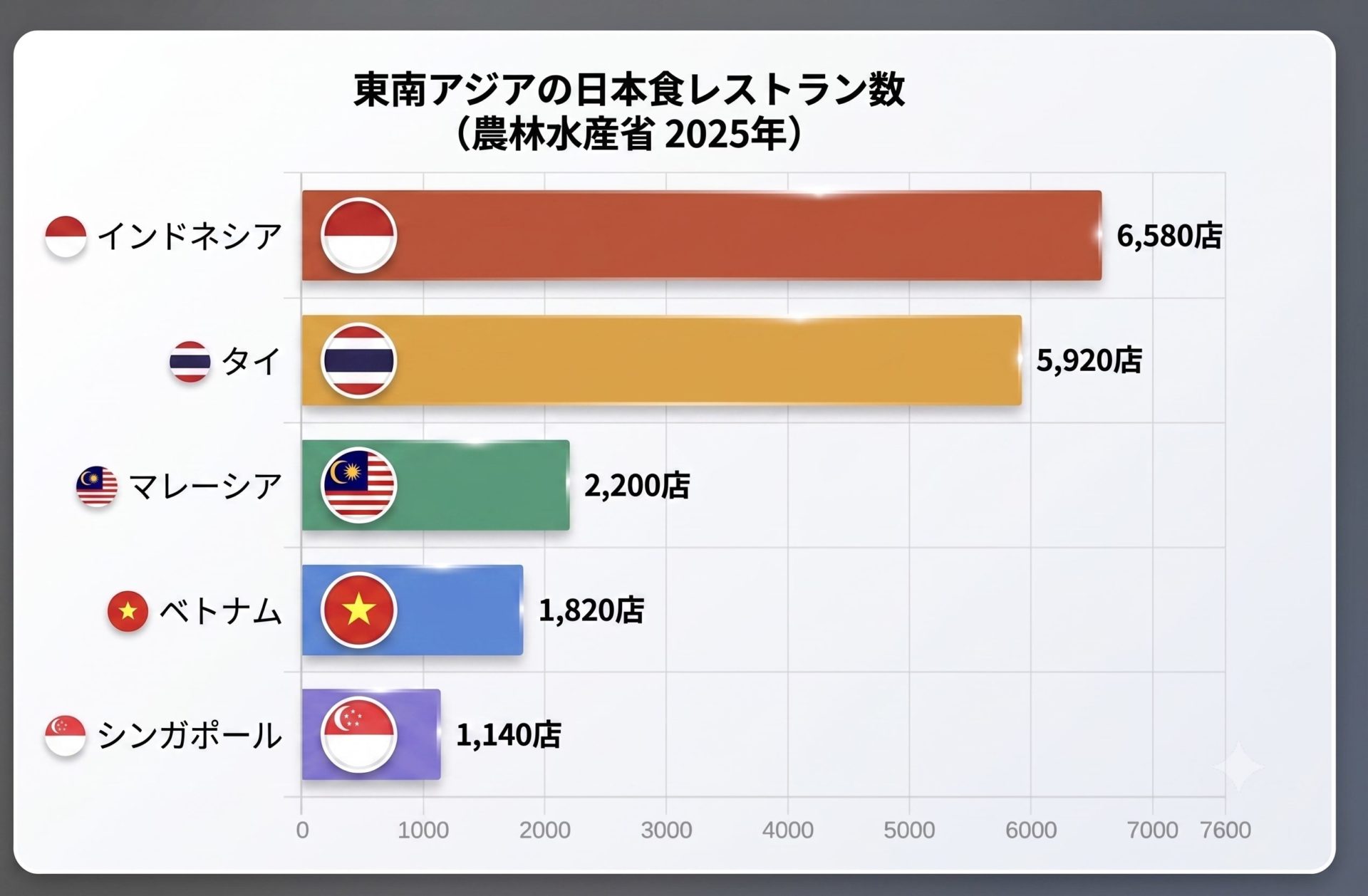
Japan's Ministry of Agriculture, Forestry and Fisheries (MAFF) counts Japanese restaurants outside Japan every two years from Ministry of Foreign Affairs data. The figures are approximate and include every restaurant that presents itself as Japanese, whoever owns it. In the MAFF table published 28 November 2025, Thailand has about 5,920 Japanese restaurants, up 590 from the 2023 survey. That places Thailand 7th worldwide after China 63,500, the United States 26,360, South Korea 19,800, Mexico 7,430, Taiwan 7,100 and Indonesia 6,580, and 5th in Asia. Within Southeast Asia only Indonesia is larger; Malaysia has 2,200, Vietnam 1,820, Singapore 1,140 and the Philippines 940. MAFF counts about 181,000 Japanese restaurants worldwide in 2025, about 6,000 fewer than in 2023, with Asia down about 9,600 mainly because of China. Thailand grew while the region shrank.
Where are they, and what do they serve?
Bangkok holds 2,609 of Thailand's 5,781 Japanese restaurants in 2025, about 45 percent, down 2.4 percent from 2,672 in 2024. The five provinces around Bangkok hold 846, down 3.1 percent, and the rest of the country holds 2,326, down 1.9 percent. (JETRO Bangkok, 2025 Survey of Japanese Restaurants in Thailand (20 January 2026))
After Bangkok, the provinces with the most Japanese restaurants in 2025 are Chonburi 355, Nonthaburi 343, Chiang Mai 270, Samut Prakan 182, Pathum Thani 168 and Phuket 137. Chiang Mai fell 3.6 percent and Phuket fell 3.5 percent in 2025 after both grew in 2024. (JETRO Bangkok, 2025 Survey of Japanese Restaurants in Thailand, provincial table (20 January 2026))
Japanese restaurants have operated in every province of Thailand since 2020. (JETRO Bangkok, 2025 Survey of Japanese Restaurants in Thailand (20 January 2026))
In 2024 the fastest provincial growth was in Chiang Mai, up 23 to 280 outlets, Nakhon Pathom, up 15 to 104, and Phuket, up 11 to 142. (JETRO Bangkok press release, 2024 Survey of Japanese Restaurants in Thailand (8 January 2025))
What do Japanese restaurants in Thailand charge?
Published prices from public sources, as of the date shown. They are reference points, not averages.
Michelin-starred Japanese restaurants in Thailand
The Michelin Guide lists 1 starred restaurants in Thailand in its Japanese and sushi categories (2026-11-05). The MICHELIN Guide Thailand 2026, announced 27 November 2025, has 468 restaurants, 43 with stars: 2 three-star, 8 two-star, 33 one-star, plus 137 Bib Gourmand. Sushi Saito is the only starred restaurant in the Japanese or Sushi categories. The official Sushi list for Thailand shows 6 restaurants, all in Bangkok: Sushi Saito with 1 star and 5 Selected (Ginza Sushi Ichi, Sushi Masato, Sushi Saryu, Jikasei B, Nikaku). The Japanese list for the Bangkok region shows 5 restaurants: Gen, Fillets, Seifu, Shirokane Tori-Tama and No Name Noodle, the last with a Bib Gourmand. The 2027 selection is scheduled for 10 November 2026. (MICHELIN Guide official site: full list of stars Thailand 2026 (27 November 2025); Thailand 2026 announcement; Sushi and Japanese category lists)
- Sushi Saito, Bangkok: 1 star, new in the MICHELIN Guide Thailand 2026 (promoted from MICHELIN Selected); cuisine listed as Sushi; Four Seasons Private Residences, 300 Charoen Krung Road
- Ginza Sushi Ichi, Bangkok: MICHELIN Selected (Sushi list, as of 2026-11)
- Sushi Masato, Bangkok: MICHELIN Selected (Sushi list, as of 2026-11)
- No Name Noodle, Bangkok: Bib Gourmand (Japanese and noodles list, as of 2026-11)
What is changing in 2026?
Who owns and opens Japanese restaurants in Thailand?
Independents dominate by brand count: 2,168 single-outlet brands in 2025, plus 407 brands with 2 to 5 outlets, 56 with 6 to 10, 38 with 11 to 50 and 13 with 51 or more. JETRO does not publish the split between Japanese-owned and Thai-owned operators. (JETRO Bangkok, 2025 Survey of Japanese Restaurants in Thailand (20 January 2026))
Japanese chains enter by direct investment: Sushiro GH (Thailand) is a joint venture with Food and Life Companies and did not franchise; Zensho runs Hama Sushi. Thai groups run many Japanese brands: Central Restaurants Group brought Tenya to Thailand in 2015 and closed its last two branches on 31 August 2025; The Food Selection Group, owner of Shinkanzen Sushi, brought in Katsu Midori; Maguro Group is launching Kaiten Sushi Ginza Onodera. (Thairath English (16 January 2026); The Thaiger (22 August 2025); The Nation (20 February 2026))
Thai-owned groups quoted by The Nation in February 2026: YUZU GROUP (Sompasuk Co.) runs Yuzu Suki with nine branches and Kogoro Katsu; Nigiwai Group targets 12 to 15 new branches in 2026, mainly its Nigiben bento brand, with about THB 200 million in revenue. (The Nation, Japanese restaurant numbers fall in Thailand for first time in 20 years (15 February 2026))
Recent openings and expansions reported in public sources:
- Hama Sushi (Zensho Holdings) opened its first Southeast Asian branch on the 5th floor of Central Pinklao, Bangkok, on 21 November 2025, with more than 80 menu items and plates from 40 baht. (Brand Inside (21 November 2025); Nikkei Asia (4 December 2025))
- Katsu Midori, a Tokyo sushi brand, opened its first Thai branch at CentralWorld in December 2024 under The Food Selection Group and had four branches by February 2026. (The Nation (20 February 2026))
- Kaiten Sushi Ginza Onodera, from the Onodera Group, is planned by Maguro Group for CentralWorld in the third quarter of 2026 as the first Southeast Asian branch (planned as of February 2026). (The Nation (20 February 2026))
- Nigiwai Group opened the first Nigiben branch at Don Mueang Airport on 23 February 2026 with approval from Airports of Thailand. (The Nation (15 February 2026))
- Tenya, the tempura chain run in Thailand by Central Restaurants Group since 2015 with 14 branches at its 2020 peak, closed its last two branches at Terminal 21 and Samyan Mitrtown on 31 August 2025. (The Thaiger (22 August 2025))
- Sushi Saito Bangkok, the sister branch of Takashi Saito's Tokyo restaurant, received one MICHELIN star in the Thailand 2026 selection announced 27 November 2025. (MICHELIN Guide (27 November 2025))
Who supplies, equips and finances these restaurants?
Fishery products are 47.0 percent of the total at JPY 34.6 billion, agricultural products 51.5 percent at JPY 37.9 billion, forestry 1.5 percent. Top items in 2025: sardines JPY 7.2 billion, scallops JPY 6.1 billion, bonito and tuna JPY 5.8 billion, beef JPY 4.4 billion, mackerel JPY 4.2 billion, green tea JPY 2.9 billion, pig skins JPY 2.9 billion, sauces and seasonings JPY 2.7 billion, instant coffee JPY 2.6 billion, caviar and substitutes JPY 1.7 billion. Thailand is the number one destination for Japanese sardines and for bonito and tuna, and the fifth largest for Japanese beef at JPY 4.44 billion, up 11.7 percent. Much of the fish is processed in Thailand rather than served in restaurants. (MAFF, 2025 export results of agricultural, forestry and fishery products and food, by country and region (February 2026, based on MOF trade statistics), Thailand pages; MAFF press release (3 February 2026), 2026-02)
Every one of these restaurants buys fish, rice, soy sauce and sake, fits out a kitchen, trains staff and signs a lease. Washoku Agent places Japanese chefs in restaurants in Thailand and 25 other countries, and every placement starts with a restaurant that is opening, expanding or changing its chef. That moment matters to the companies behind the restaurant as much as to the owner. For the importers and wholesalers already serving Japanese kitchens here, see our guide to Japanese food suppliers in Thailand.
Hiring Japanese chefs in Thailand
Owners who open or expand in Thailand ask the same three questions: which visa, what to pay, and how to keep the chef past the first year. Our guide to hiring and managing Japanese chefs in Thailand answers them with official visa rules and the positions we have handled, and What restaurants pay Japanese chefs in six countries puts the advertised salaries side by side. To see what individual restaurants offered since 2025, country by country, open What restaurants offered Japanese chefs abroad.
Frequently asked questions
How many Japanese restaurants are there in Thailand?
About 5,920 according to MAFF's count published 28 November 2025, and 5,781 according to JETRO Bangkok's survey conducted August to October 2025 and published 20 January 2026. The two counts use different methods; JETRO counts only seated restaurants with a majority Japanese menu.
Is the number of Japanese restaurants in Thailand growing?
No, it fell in 2025 for the first time since JETRO began counting in 2007: 5,781 outlets, down 135 or 2.2 percent from 5,916 in 2024. MAFF's count still shows growth between its 2023 and 2025 surveys, up 590 to about 5,920.
Where are most Japanese restaurants in Thailand?
Bangkok, with 2,609 outlets in 2025, about 45 percent of the national total. The next largest provinces are Chonburi 355, Nonthaburi 343, Chiang Mai 270 and Phuket 137, per JETRO Bangkok.
Which Japanese food formats are growing in Thailand?
Ramen, up 2.6 percent to 823 outlets, and Japanese cafes, up 6.4 percent to 350 outlets, were the only categories to grow in 2025. Conveyor-belt sushi chains such as Sushiro and Hama Sushi are expanding while yakiniku fell 9.0 percent, per JETRO Bangkok and The Nation.
How much does Japan export to Thailand in food?
Japan exported JPY 73.5 billion of agricultural, forestry and fishery products and food to Thailand in 2025, up 17.1 percent, making Thailand the 7th largest destination. Top items were sardines, scallops, bonito and tuna, beef and mackerel, per MAFF.
Opening or growing a Japanese restaurant? You can bring in an experienced Japanese chef for a defined piece of work, such as a new menu, training for your team, or help with an opening. See how a project works.
Sources (checked 2026-11-05)
- MAFF, Approximate number of Japanese restaurants overseas by country and region (28 November 2025)
- MAFF press release, Survey results on the number of Japanese restaurants overseas, 2025 (28 November 2025)
- JETRO Bangkok, 2025 Survey of Japanese Restaurants in Thailand, full report (20 January 2026)
- JETRO Bangkok press release, 2025 Survey of Japanese Restaurants in Thailand (20 January 2026)
- JETRO Bangkok press release, 2024 Survey of Japanese Restaurants in Thailand (8 January 2025)
- JETRO, Basic marketing information for agricultural and food products, Thailand (updated July 2026)
- MAFF, 2025 export results by country and region (February 2026)
- MAFF, 2025 export results by item (February 2026)
- MAFF press release, 2025 export results of agricultural, forestry and fishery products and food (3 February 2026)
- MICHELIN Guide, The full list of MICHELIN star restaurants in the MICHELIN Guide Thailand 2026 (27 November 2025)
- MICHELIN Guide, Thailand shines brighter with 10 new MICHELIN star additions (27 November 2025)
- MICHELIN Guide, Sushi Saito Bangkok listing (accessed 5 November 2026)
- MICHELIN Guide, Thailand Sushi restaurants list (accessed 5 November 2026)
- MICHELIN Guide, Bangkok region Japanese restaurants list (accessed 5 November 2026)
- The Nation, Thailand's Japanese restaurant market hits maturity as numbers dip (20 January 2026)
- The Nation, Japanese restaurant numbers fall in Thailand for first time in 20 years (15 February 2026)
- The Nation, Conveyor-belt sushi market hits THB 8bn, shaking up Japan dining in Thailand (20 February 2026)
- The Nation, Japanese restaurants flourish in Thailand, nearing 6,000 nationwide (10 January 2025)
- Nikkei Asia, Thailand sees first decline in Japanese restaurants in 2025 (24 January 2026)
- Nikkei Asia, Thailand sushi battle heats up between Japan chains, local players (4 December 2025)
- Thairath English, Decoding how Sushiro sells sushi to keep Thai customers queuing (16 January 2026)
- The Thaiger, Tempura favourite Tenya exits Thailand after 10 years (22 August 2025)
- Brand Inside, HAMA-SUSHI opens its first branch in Thailand (21 November 2025)
- TAT Newsroom, TAT celebrates three new Japan to Bangkok flights (4 December 2025)
- JNTO press release, Visitor arrivals December 2025 estimate and 2025 total (21 January 2026)
- 1,820 Japanese Restaurants in Vietnam: Where They Open and Who Supplies Them (2026)
- 1,140 Japanese Restaurants in Singapore: Where They Open and Who Supplies Them (2026)

Related posts

2,230 Japanese Restaurants in Australia: Where They Open and Who Supplies Them (2026)
1,140 Japanese Restaurants in Singapore: Where They Open and Who Supplies Them (2026)
1,820 Japanese Restaurants in Vietnam: Where They Open and Who Supplies Them (2026)
